


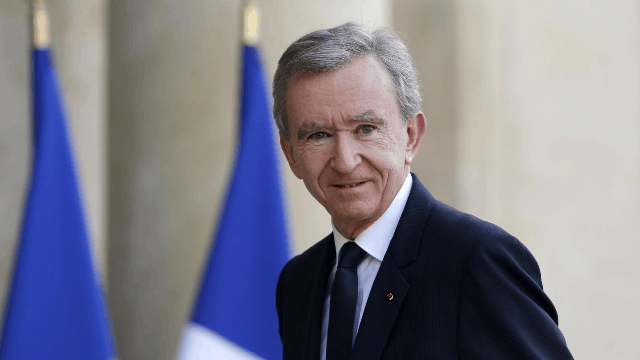
As one of the world's top brands, LV has also created immeasurable business value, which has made the head of LV, Bernard Arnault, the richest man in France, so let's take a look at his path to building a luxury empire.
First appearances
Bernard Arnault's hometown is the industrial city of Roubaix in northern France. His mother's family ran a small and prestigious construction company in the area and Bernard grew up under the care of his maternal grandparents. After graduating from the Ecole Polytechnique in Paris as a young man, Bernard briefly worked for a consultancy firm before joining his family's construction company. His strong personality, his tendency to seek absolute decision-making power over things, was already showing its first signs at this time.

Shortly after entering the family business, Bernard and his father soon disagreed on the direction of the company. Bernard proposed to get rid of all of the company's industrial construction business and to focus on developing individual properties, mainly in the construction and sale of flats and holiday homes.
After Bernard was overruled by his father, he set out to lobby the other executives of the company. Things eventually ended in Bernard's favour and, under collective pressure from the company's executives, his father finally gave the go-ahead to sell the company's industrial construction business and public affairs division to Guillery, a French company owned by the Rothschild family. This restructuring of the business dramatically reduced overall operating costs and greatly improved the company's financial position.
A few years later, at the age of 28, Bernard took over the sceptre of the company's CEO from his still-young father and soon afterwards successfully became chairman of the company.
The absolute control of the family business, and the fully convincing image he established, became the solid foundation on which he would later take over Dior and build his luxury empire.
The Dior complex
In 1981, the real estate development business of Bernard's family construction company, which focused on small boutique homes, never opened up a market in the United States. Bernard closely monitored the movements of his homeland until three years later, when the French economic policy began to turn and regulation began to gradually untie capital, Bernard did not hesitate to set off for home as the wave of French capital began to return. Although the family business did not grow as much in the US, those three years were invaluable to Bernard. He was able to look at his home country from a different perspective, outside of his usual environment, and this had a profound impact on Bernard's life later on.
Bernard himself once mentioned an anecdote in an interview about a taxi driver in the US with whom he had a chat, and when he mentioned France, the taxi driver jokingly said: "I don't know Georges Pompidou, "but I know Christian Dior".
The power of art and branding, completely rooted in Bernard's heart
In 1984, Bernard returned to France from the United States. The first target he set his sights on was Dior. Arnott borrowed $80 million against his family's assets and then, in conjunction with Lazard Bank, succeeded in acquiring Boussac on the terms of a personal contribution of 150 million francs, for a total of 400 million francs in subscription capital, thanks to a capital commitment given by him and the support of two oil industry investors. It was a classic snake swallowing an elephant takeover, with Busac more than doubling the size of the Arnott family business, and by then the rival to Arnott to the end was his later bag, the LV Group.
For the next three years, Arnott devoted all his energy to restructuring the assets and debts of Bussac. There is no doubt that for a business that was to make money, these restructurings were useful. Bernard spun off Dior and eventually sold the group as a whole for four times the price he paid when he bought it, for a considerable cash gain. This gentleman, who appears ever so gentle in front of the camera, has been named the winner of Best Dressed Man on several occasions, but he acts in an extremely tough manner and is never shy about stirring up one bloodbath after another with his own hands.
With Dior, Arnault is officially a rising star in the luxury industry. But his Dior love affair still profoundly influences the direction of the story later on.
Not just a capitalist, but also an entrepreneur
If mergers and acquisitions make a company bigger and its brands more numerous, it does not necessarily mean that it becomes stronger. Many people who specialize in capital operations only move assets around and play market value management or valuation games, without really helping to increase the internal value of the business, which is typical of capitalists and managers.
But Arnott is not. The name Bernard Arnault represents not only an iron hand, but also the soul of the brand, with its outstanding artistic mastery. He also gives a masterful performance in the management and creation of luxury brands.
Bernard has confided the secret of his success: "Luxury brands are much more difficult to establish than other businesses, they require the creation of a consumer demand that simply does not exist, and shaping a fashion luxury brand must follow a formula: define the brand identity by digging into its history and interpreting it with the right designers."
Unlike the absolute control sought at the level of the company's shareholding, Bernard is rather less of a proponent of centralism with regard to the day-to-day running of the business.
In the case of LVMH, for example, after a major purge and an overhaul of its business structure, the organization has not become more hierarchical, but more flexible and dynamic. All of its internal unit brands are independently run, independently managed and independently developed into brand management strategies. And it was Bernard himself who became the staunchest defender of this diversified organizational structure and independent operating mechanism.
He ensures his control over the direction of the company with a controlling stake, and ensures the vitality and creativity of the brand with a diversified, loosely flat structure. In this sense, Bernard has become not only a capitalist and a professional manager, but also a highly successful entrepreneur.